
Missions
Every student needs somewhere to begin.
Sometimes the hardest part of creating is the empty box. Missions replace it with a problem worth solving.
Nothing to prepare
Already in the product
No right answer
By design, not by accident
Said out loud
How a class starts in seconds
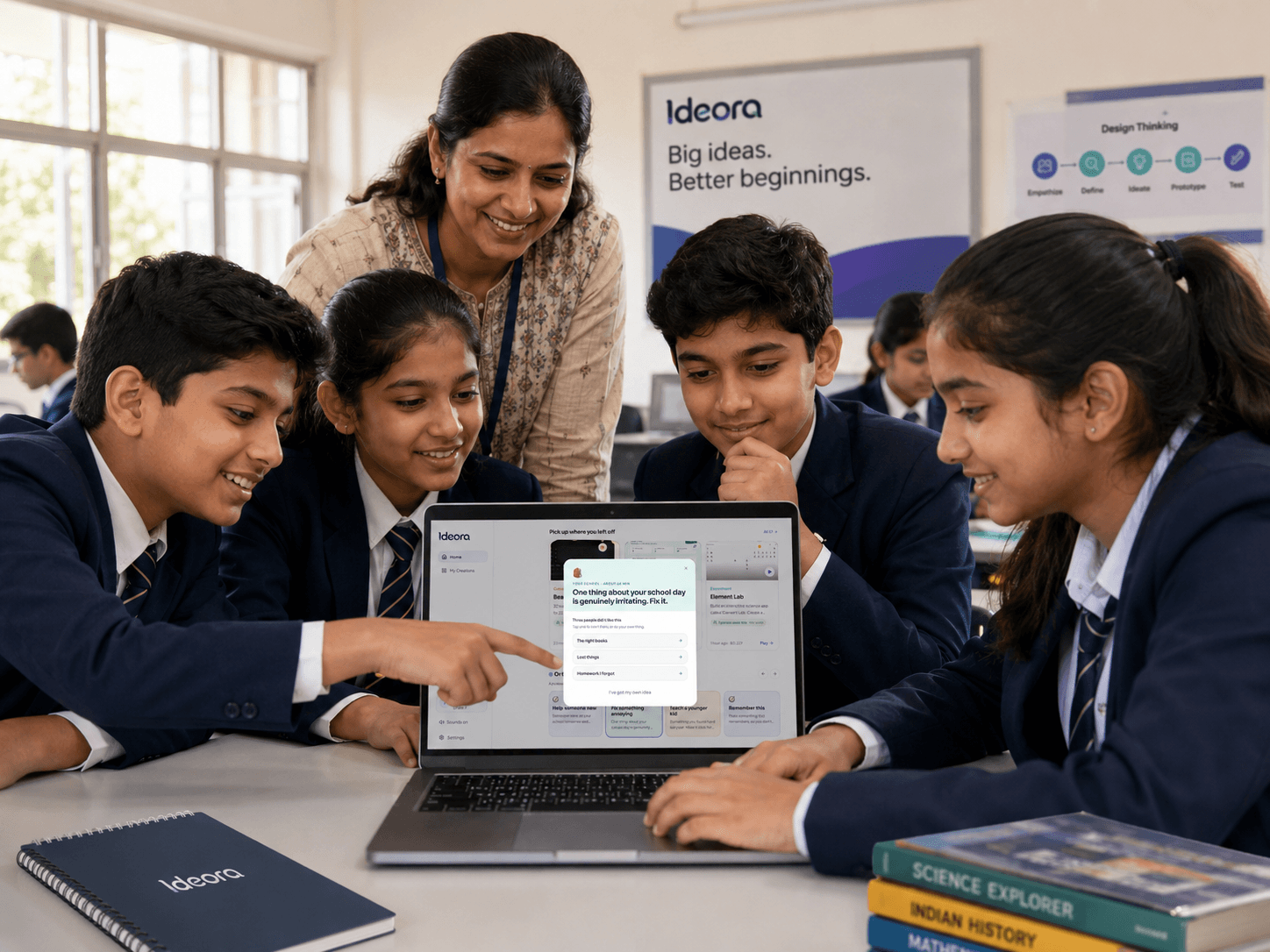
A problem, not an assignment
A Mission is a situation with no single right answer. “Someone starts at your school tomorrow and knows nobody. What could you create for them?” Thirty students will read that and go thirty different ways, which is exactly what makes it worth setting — and what makes copying somebody else's work pointless rather than forbidden.
- There is no single right answer.
- A teacher can set one out loud, for the whole class at once.
- Every student's outcome is different, so nobody copies.
A Mission is not an assignment
The difference is not tone. It changes what students do in the first five minutes.
| An assignment | A Mission | |
|---|---|---|
| What the student asks first | What does the teacher want? | What would actually help? |
| How many right answers | One | As many as there are students |
| What copying gets you | The same marks | Somebody else's idea, which is no use |
| What the teacher marks | Distance from the expected answer | The decisions the student made |
| What it needs prepared | The task, the rubric, the exemplar | Reading one sentence aloud |
Say the second sentence out loud
“There is no single right answer, and I genuinely do not know what you will make.” It sounds like a throwaway line and it does more work than the Mission itself — it moves a room from guessing what the teacher wants to deciding what they want, which is the whole point of the lesson.
Or skip the Mission entirely
For students who already know what they want to make, five shortcuts:
- Web App
- AI App
- Website
- Game
- Creative
One Mission. Thirty students. Thirty different directions.
Questions about Missions
No. Missions are already in the product. A teacher reads one out and the class starts.
Yes. Missions exist for the blank-page moment. A student who already knows what they want can start from a kind of Creation instead, or simply describe their idea.
An assignment has an expected answer. A Mission does not — which is why thirty students produce thirty different Creations from the same sentence, and why the interesting assessment evidence is the decisions rather than the artefact.
Yes. Outcomes differ between classes as much as within them, so a Mission does not go stale after one use.
Let them start it. Ideora asks clarifying questions, produces a first version quickly, and the scope conversation then happens against something real rather than in the abstract — which is a much better conversation.
See a class start from one Mission.
Thirty students, in the same minute, going in different directions.